Tuesday, 5 April 2011

Successful development of the 2nd International Expert Workshop on PMR

Dr. Costas Kadis (Frederick University of Nicosia), main scientific responsible of the workshop, goes on with its presentation on the Cypriot 'PLANT-NET CY' LIFE+ project © E.Laguna, 05.04.2011

Today, in the framework of the PLANT-NET CY project, Nicosia held the 2nd International Exepert Workshop on Plant Micro-Reserves (PMR), under the cordination of the Cypriot Department of Environment and the Frederick University. The recruitment of participants and scientific coordination of the meeting was made by Dr. Costas Kadis (Frederick University at Nicosia).

The meeting hosted presentations from Cyprus, Spain, Greece, Slovenia, Latvia, Bulgaria and Rumania, and covered case-studies of pilot projects on PMR both developed under the umbrella of the EU's LIFE programme and out of this framework; in addition, embrionary proposals to develop future PMR projects were exposed -case of Rumania, where the selection of IPAs (Important Plant Areas)- allowed a fine selection of sites to be proposed as PMR in the future.


Dr. Costas Thanos (National and Kapodistrian University of Athens, Greece) proposed several interesting initiatives to start the networking tasks for a future platform of PMR expertises, institutions and projects in Europe. © E.Laguna, 05.04.2011
As a main issue of the meeting, the first steps to go set up a network of European PMR experts and institutions has been discussed and agreed. Several electronic forums like webpages, blogs and Facebook's pages could be launched in a few time (so please pay attention during the next weeks and months¡).

PLANTNET-CY: 2nd Meeting of the Scientific Committee

A moment of the SC meeting © E. Laguna, 04.04.2011

The headquarters of the Cypriot Department of Environment in Nicosia held yesterday the second meeting of the Scientific Committee (SC) which monitor and advices the development of the LIFE+ project PLANT-NET CY 'Establishment of a plant micro-reserve network in Cyprus for the conservation of priority species and habitats'. As explained and discussed during the SC meeting the project ongoes correctly, being in time for most of the foreseen actions. The SC included representatives of the different partners of the project, both from Cyprus and Greece -case of National and Kapositrian University of Athens, represented this time by Dr. Costas Thanos-, as well al Drs. Emilio Laguna and Vicente Deltoro (Generalitat Valenciana's Biodiversity Service), coming from Spain.

Drs. Emilio Laguna, Costas Thanos and Costas Kadis review the planning to prepare and edit the future book on the PMR initiative across Europe. © V. Deltoro, 04.04.2011
As a special issue, a final micro-meeting (on micro-reserves¡) joined Dr. Costas Kadis (main Scientifical Coordinator of the project, Frederick University of Cyprus), Dr. Costas Thanos and Dr. Emilio Laguna, as main responsibles of the book on PMR initiative to be edited in the PLANT-NET CY project framework. A first list of contents (index) was drafted and agreed, to be implemented during the next months.

Saturday, 26 June 2010

PMRs and restoration ecology

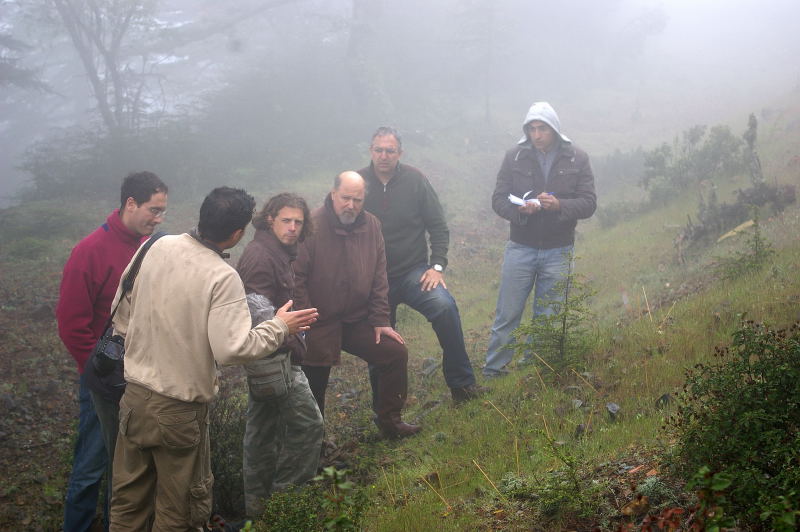
Dr James Aronson (2nd from left) and Dr Luis Balaguer (4th) visit the sightening area of the PMR 'Teixera d'Agres', with the plant conservation officers Xavier Garcia (1st from the left, CIEF's expertise in Yew conservation) and Dr Joan Pérez-Botella (3rd, Generalitat Valenciana's Biodiversity Service in Alicante province) © E. Laguna, 23.05.2010, Agres, Alicante, Spain.

The Valencian Plant Micro-reserves network has been choosed by Dr. James Aronson (Head of Restoration Ecology group in the Centre for Functional and Evolutionary Ecology, CEFE-CNRS, Montpellier, France) and his close collaborator Dr. Luis Balaguer (Complutense University of Madrid, Spain) as one of the examples of results in active works of restoration ecology, during a tour made during these weeks through Spain. Dr. Aronson is one of the most cellebrated researchers and practicioners on restoration ecology around the world, as well as one of the most relevant members of the SER (Society of Ecological Restoration), being the Series Editor of the SER & Island Press Ecological Restoration Book Series "The Science and Practice of Ecological Restoration". During their visit to the Valencian Community, Drs. Aronson and Balaguer joined plant officers carried out of plant restoration projects in the Service of Biodiversity and the CIEF (Centro para la Investigación y Experimentación Forestal), and discussed on selected topics of the works developed in the PMR network. A joint excursion with managers of PMRs and plant conservation officers was made to the PMR 'Teixera d'Agres' (Agres, Alicante), where Drs. Aronson and Balaguer could see in situ actions to restore the ancient local forests of Yew (Taxus baccata), seriously damaged by forest fires and plantations of exotic invasive species (Robinia pseudoacacia).

CIEF's plant conservation officer Pablo Ferrer discuss with Drs. James Aronson and Luis Balaguer on restoration problems found and goals proposed for the PMR network. © E. Laguna, 23.05.2010.

Interest on PMRs from Australia

Paul Donatiu (left) and the PMR officer Patricia Pérez-Rovira (right) visits the PMR 'Platja d'Almenara', a coastal dune site seriously threatened by the marine erosion during the last years. This PMR holds the unique remain of continental populations of the Ibero-Balearic endemic Silene cambessedessii. © E. Laguna, 31.05.2010

In a recent visit, the coordinator of the Association for National Parks of Queensland (Australia), Mr Paul Donatiu, visited the Valencian Community (Spain) to know in situ the success of the Plant Micro-Reserve (PMR) initiative, which currently reaches 273 protected sites for wild plants. The Valencian PMR team and expertises of the Generalitat Valenciana's CIEF (Centro para la Investigación y Experimentación Forestal), as well as Dr. Josep A. Rosselló (University of Valencia Botanical Garden and Carl Faust Foundation at Blanes, Girona) provided technical advice to Paul Donatiu and discussed about the role of PMRs and other conservation designations to ensure the protection of small refugees for wild plants and relictic vegetation, both for glacial relicts and thinking of the effects of climatic change.

Starting a new PMR network in Bulgaria

The Institute of Botany of the Bulgarian Academy of Sciences (IB-BAS) starts in 2010 a new LIFE+ project co-finances by the EC to create a pilot network of small protected sites in Bulgaria, using the PMR approach. The project is piloted by the cellebrated Bulgarian botanist Prof. Dr. Dimitar Peev, and proposed the establishment of a network of 56 PMRs to ensure the conservation of a large list of rare, threatened and protected species which do not matches sufficiently the current network of protected sites. This project will ongoes since 2010 till mid 2013, and at least 30 small protected sites (SPS) will be legally established during that period.

Map with the distribution of the 56 proposed SPS for wild plants in Bulgaria, provided by the LIFE+ project drafted by the IB-BAS

As proposed in the LIFE+ project, a first technical meeting with attendance of Bulgarian expertises and students will by made the next week, 28-30th June 2010 in Sofia. The attendance of 3 expertises from the Valencian PMR pioneer project is foreseen, in order to explain the results, success and difficulties found to built up the Valencian PMR network.


Astragalus physocalyx, one of the most important species to be conserved through the Bulgarian PMR project. Picture provided by IB-BAS.

Interested researchers, managers and naturalists can found a fact sheet of the project following the link:
http://ec.europa.eu/environment/life/project/Projects/index.cfm?fuseaction=home.createPage&s_ref=LIFE08%20NAT/BG/000279&area=1&yr=2008&n_proj_id=3541&cfid=160792&cftoken=8c0a87b8ab139d7-756618B8-CEC3-5655-6EA31FEE73133EC8&mode=print&menu=false

Cyprus LIFE+ project on PMRs ongoes


The leaf of Goldean Oak (Quercus alnifolia), the endemic oak of Cyprus, is the main topic of the project logo. © E. Laguna, 12.04.2010.

This year started the new project on the establishment of a PMR network in Cyprus, approved by the EC in 2009 for the period 2010-2013. The main benefitiary is the Ministry of Agriculture, Environment and Natural Resources of Cyprus, and the scientifical coordination is piloted by Dr. Costas Kadis, from the Frederick University.

The first meeting of the scientific committee of the project was held in Nicosia, 12-14th April 2010, joining expertises from Spain, Greece and Cyprus, as well as the external services of the EC's LIFE+ programme. At the same time, a first meeting of the stearing committee of the project, formed by representatives of all the benefitiary entities, was held the 13th April 2010.

In situ discussion on the conservation practices to be carried out with Arabis kennedyae, in the PMR proposed in the cedar forests (Cedrosetum brevifoliae), Troodos Mts. ©E. Laguna, 12.04.2010

During the meeting, the main schedule and goals of the project were reviewed and discussed, and visits to all the sites to set up the PMRs were made. A set of 5 sites will protect selected natural sites for Centaurea akamantis, Ophrys kotschyi, Astragalus macrocarpus subsp. lefkarensis, forests of Quercus alnifolia, and both populations of Arabis kennedyae and forests of Cedrus brevifolia.


Dr Costas Kadis explains the behaviour and results of firsts census of Centaurea akamantis, in the PMR focused in its protection in the cellebrated Avakas Gorge, near Paphos. ©E. Laguna 14.04.2010

Fruits of Astragalus macrocarpus subsp. lefkarensis, near Asgata. ©E. Laguna, 12.04.2010

Dr. Costas Kadis (Frederick University of Cyprus), Dr. Vicente Deltoro (Plant Microreserves Project, Generalitat Valenciana, Valencia, Spain) and remainder attendants to the meeting visits the PMR proposed for Quercus alnifolia forests at the Troodos Mts. ©E. Laguna, 12.04.2010

A sheet with basic information on the project can be found following the link:
http://ec.europa.eu/environment/life/project/Projects/index.cfm?fuseaction=home.createPage&s_ref=LIFE08 NAT/CY/000453&area=1&yr=2008&n_proj_id=3570&cfid=160792&cftoken=8c0a87b8ab139d7-756618B8-CEC3-5655-6EA31FEE73133EC8&mode=print&menu=false

Sunday, 14 June 2009

Important step for the protection of Calendula maritima


Calendula maritima. Picture extracted from the IUCN website (www.iucn.org) © Anna Giordano for the IUCN's MIPSG-SSC Top 50 of Mediterranean Island Plants. This image is a link to the IUCN booklet. Please consult there the page 92-93.

The Sicilian endemic plant Calendula maritima Guss. is one of the most relevant endangered species of the Mediterranean basin (see information in the Top50 list of Mediterranean Island Plants (http://cmsdata.iucn.org/downloads/mediterranean_top50_en.pdf). Its conservation, including the proposal to give protection to the small sites where the species lives, has been largely defended by the Sicilian botanists, and particularly by Dr. Angelo Troià, former director of the Nature Reserve Saline di Trapani e Paceco, and one of the most enthusiastic defenders of the PMR philosophy. Most populations of C. maritima remain unprotected and even the classical one, found into the nature reserve boundaries, was threatened by the projected enlargement of a close harbour in Marsala.

The Regional Province of Trapani, following the proposal of his councilior Mr. Salvatore Daidone, has recently passed an amendment to the regional provisions, in order to improve the long-term protection of the species, and to convert it into a province symbol for nature conservation. A recent letter received from Mr. Girolamo Turamo, president of the Province of Trapani, confirm us the approval of this proposal. Please receive our congratulations from this blog, and our desire to go on with the conservation of this endangered species.

Wikipedia link: http://en.wikipedia.org/wiki/Calendula_maritima IUCN redlist fact sheet: http://www.iucnredlist.org/details/61618/0

Dr. Angelo Troìa presenting the results of the project EOLIFE for the conservation of endangered plants of the Eolian Islands (Sicily, Italy), during the international workshop on PMRs organized by Dr. Costas Thanos in The Mediterranean Agronomic Institute of Chania (Crete, Greece), 24.11.2005, © Emilio Laguna

Tuesday, 26 May 2009

New issue on the Valencian PMRs

A few days ago the Valencian Government (Valencian Community, Spain) passed the new decret on plant conservation (Decree 70/2009, May 22, which creates and regulates the Valencian Catalogue of Threatened Flora, DOCV nr. 6021, 25.05.2009) which includes some improvements for te Valencian Plant Microreserves Network. The most important issue is the enlargement of the territory able to set up new PMRs, due that since 1994, these reserves only could be made on the emerged (oversea) regional territory -the sum of the three Valencian provinces: Castellon, Valencia and Alicante-; after lots of legal conflicts between the Spanish administration and the regional ones (as those of the Valencian Community), the Spanish Law 42/2007 (november 2007) on Natural Heritage and Biodiversity, redistributed the responsability on the coastal conservation, empowering the Authonomous Communities (=regions) to create protected sites and manage the biological resources of marine areas near their respective coasts. So, in a close future, the Valencian PMR network also could include marine microreserves, mainly thinking of the fine protection of plant communities hosting marine phanerogams (Posidonia oceanica, Zostera spp. etc.) and bentic algae. The Valencian Decree is only available in Spanish and Valencian/Catalonian languages:

Sunday, 17 May 2009

Cyprus' LIFE proposal to made a PMR network is ongoing

A LIFE-funds application presented months ago by several institutions from Cyprus and the UNKA (Athens, Greece) under the coordination of Dr. Costas Kadis (Frederick Intitute of Technology) has been initially accepted by the EC's LIFE Unit to be co-financed during the next years, in order to create a Plant Microreserves Network, adapting the model of the successful LIFE project CRETAPLANT -so paying special attention to the species listed at the Habitats Directive-. In a few months, all kind of bureaucratic procedures and engagements will be signed in order to start the works as soon as possible.

Wednesday, 6 May 2009

Planta Europa launches the EIP initiative


Planta Europa has launched the 'European Information Platform for Plants' (EIP), where the plant microreserves have a specific information sheet as relevant case study for plant conservation. The EIP initiative is maintained from Plantlife International, and you can access the information through the Planta Europa website www.plantaeuropa.org or directly clicking on the banner above, on this message
Please, find below the letter spreaded from the Planta Europa secretariat, sent by Beth Newman to the Planta Europa members. The readers belonging to no-member institutions are invited, in any case, to joint the initiative (and of course to join Planta Europa!):
------
TODAY WE ARE LAUNCHING THE PLANTA EUROPA - EUROPEAN INFORMATION PLANT FOR PLANTS (THE EIP).

The European Information Platform for Plants (EIP) is part of the Planta Europa Network website dedicated to providing information that will help everyone engaged in plant conservation activities, and will track the implementation of the European Strategy for Plant Conservation.
At the Plant Europa conference in Cluj Napoca, participants led the development of the second edition of the European Strategy for Plant Conservation (2008 -2014). During discussions, it was clear that sharing information and expertise on plant conservation was, and would continue to be, a very important part of helping stakeholders to implement this Strategy. The conference proposed that an information service should be provided for many of the new targets on the Planta Europa website, and the outgoing Planta Europa secretariat ( in particular the Planta Europa Assistant Ainhoa Mendizabal) has been working hard to develop such an information service on the web.

So here it is: http://www.plantaeuropa.org/EIP_index.htm The EIP can also be reached from the home page of the Planta Europa website, www.plantaeuropa.org (from the bottom of the left hand navigation panel).

The site has three main elements
1. Details of the progress towards the targets of the European Strategy for Plant Conservation
2. Country profiles - information on plants, fungi and conservation in each European country ( from information that used to be on Plant Talk website, collated by Hugh Synge and Melanie Bilz)
3. Case studies, tools and contact information on specific plant conservation projects that contribute to the implementation of the ESPC.
Use the left hand navigation panel to reach these three areas.
WHAT YOU CAN DO
- Use the EIP
- Promote the EIP to your colleagues and other conservation organisations in Europe
- Contribute information on your projects by filling in the templates and sending them to Plantlife International who are managing this site (send to enquiries@plantlife.org.uk)
- Simply to tell us what you think!
The EIP has been produced through the efforts of the Planta Europa Network members, the Secretariat and with some information from the former website of Plant Talk. We hope that it will allow more fluent communication among users, where emerging issues, suggestions, successful projects and new ideas will be collected.

Welcome to your project. Welcome to the EIP Planta Europa

Beth Newman
European Biological Information Management Officer Plantlife International - The Wild Plant Conservation Charity

Tuesday, 7 April 2009

The Cretan PMR project in a new LIFE-Focus publication


The LIFE project CRETAPLANT has been choosed by the EC's LIFE-Unit as representative of good practices for nature conservation, worthing a specific chapter in the recently published booklet 'Learning for LIFE'. You can download this book from the folloqing website:

Sunday, 1 March 2009

10th River Restoration Conference

Rivers and wetlands are one of the richest ecosystems often selected to made new small nature reserves; additionally, restoration and best prectices for their conservation are common issue, interesting to the 'microreservists'. The events webpage of the EU's LIFE programme announces the forthcoming 10th Conference on River Restoration, to be held in Nottingham (UH), next 1st-2nd April. Please find below the notice, also available at http://ec.europa.eu/environment/life/news/events/events2009/april09.htm#river

--------
The aspiration of this conference is to provide a forum where ideas can be discussed across disciplines. Topics might include the following where river restoration or habitat enhancement is an integral part of the project: Flood risk management working with natural processes; climate change proofing; river basin projects ; benefits and effectiveness of schemes for habitat enhancement ; indicators for appraisal and evaluation; urban regeneration; planners and urban design.
A programme will be prepared and circulated in the New Year along with details of the conference costs. It is aimed to keep costs as close to those in 2008 as possible (i.e. circa £275 for an RRC member as a residential participant).
This is a possibility for LIFE projects to contribute. If you are interested in presenting a paper or poster please send your abstract to the
river restoration centre by 7 November 2008.
For more information about this conference refer to the
website.

Monday, 16 February 2009

The Slovenian PMR in a new LIFE-Focus publication

The series LIFE-Focus edited by the European Commission's LIFE Unit, has recently published the book "LIFE and Europe's grasslands - Restoring a forgotten habitat", donwnloadable from the webpage below indicated. Therein you will find lots of examples of grasslands protection and conservation practices, including the LIFE project on the conservation of the Karst Edge (Kraski Rob) species and habitats, one of their actiities was the selection of 30 future microreserves -citated as 'micro-areas' in the LIFE's book-. Of course, you will laso find lots of interesting and successful results of grasslands management, species conservation, etc. Please click on the following link:

Wednesday, 19 November 2008

10 years of Valencian Plant Microreserves

PMR 'Illa Ferrera', included in the Nature Reserve of Columbretes Islands, was the first protected microreserve. © E, Laguna. 10.1997

The first legal rule to protect a plant microreserve worldwide under the legal name 'microreserve' was passed by the Valencian councilior of environment the 16.11.1998, and entered in force after its publication in the official gazette (Diario Oficial de la Generalitat Valenciana), 02.12.1998. That first Order established the official declaration of 14 PMRs in the province of Castellon. The first one was the island 'Illa Ferrera', forming part of the Nature Reserve of Columbretes Islands. Ferrera is a small island (ca. 1 ha) conserving the last remainders of the extinct climax vegetation of Columbretes archipelago -a brushland dominated by Pistacia lentiscus, Smilax aspera and Chamaerops humilis-, as well as good representativeness of the most valuable local endemics, Lobularia maritima subsp. columbretensis, and the luzerne tree Medicago citrina.

Updated information on the Valencian PMRs

Current data on the Valencian PMR can be consulted at the list available via http://es.geocities.com/microreserves By the end of 2008, the Valencian Community holds 273 officially protected plant microreserves which enclose populations of more than 1.625 species of vascular plants. 1.288 populations of 527 species are targeted for long-term monitoring. The protected surface reaches 1.918 ha, but most PMRs are under 2 ha size.

Sunday, 15 June 2008

New EC's brochure on LIFE and plant conservation issues

The European Commission has recently edited the book 'LIFE and endangered plants - Conserving Europe's threatened plants', which include a section on the pioneer Valencian plant microreserves project, as well as the CRETAPLANT. The foreward of Mr. Patrick Murphy, EC's Head of Unit on Nature and Biodiversity, includes a special mention on the Plant Microreserves (PMRs), and both the Valencian and Cretan projects holds a special logo as 'LIFE PMR projects'. Please download the PDF book from
http://ec.europa.eu/environment/life/publications/lifepublications/lifefocus/documents/plants.pdf

Sunday, 30 December 2007

Happy new year 2008

'Micro' starts with the smaller forms of wild plants: seeds and seedlings!!. Here you are the Christmas card sent by Dr Costas Thanos including the logo of the CRETAPLANT project.
Christmas card sent from Dr. Costas Thanos, National and Kapodistrian University of Athens.

The blog unit of 'Plant Microreserves' wishes to all the visitors a happy new year 2008, waiting for new PMR proposals.
Some news?, go on with: In a few time, the Generalitat Valenciana will protect 14 new plant micro-reserves (so raising a network of 273 protected PMRs). In addition, by April 2008, the Frederick Institute of Technology (Nicosia, Cyprus) will hold a technical meeting on PMRs. The blog will inform you during the next moths!!!

Recent Greek presentations on PMRs

The Greek PMRs team leaded by Dr. Costas Thanos (National and Kapodistrian University of Athens) has recently presented a couple of communications to the international conferences MEDECOS XI and SEED ECOLOGY II. Please find here temporary links to the extended abstracts:
*Thanos C.A., Fournaraki C., Georghiou K., Dimopoulos P., Bergmeier E. (2007). The Establishment, Monitoring and Management of a Pilot Network of Micro-Reserves in Western Crete for the Conservation of European Threatened Plants (CRETAPLANT Project, EU-LIFE), pp. 249-250, Conference Proceedings, MEDECOS XI, the International Mediterranean Ecosystems Conference, Perth, Western Australia, Australia, September 2-5, 2007. Abstract available at
http://www.uv.es/elalum/ThanosMedecosXI.pdf
*Fournaraki C., Remoundou I., Thanos C.A. (2007). Ex situ Conservation of European Threatened Plants in Western Crete, Greece (CRETAPLANT project, EU-LIFE), p. 24, Conference Proceedings, SEED ECOLOGY II - The 2nd International Society for Seed Science Meeting on Seeds and the Environment, Perth, Western Australia, Australia, September 9-13, 2007. Abstract available at http://www.uv.es/elalum/FournarakiSeedEcologyII.pdf


The Greek researchers Ch. Fournaraki (Mediterranean Agronimic Institute of Chania, MAICh) and C. Thanos (National and Kapodistrian University of Athens), during the meeting on PMRs cellebrated in the MAICh (Chania, Crete), in the framework of the LIFE-Nature project Cretaplant. © E. Laguna 25.11.2005

For additional information, you can contact Dr. Thanos at his email address cthanos@biol.uoa.gr ; website http://www.biology.uoa.gr/~cthanos/ Other presentations issued in 2007 on PMRs are available at http://www.uv.es/elalum/cluj.htm

Wednesday, 19 September 2007

Cyprus' supporter of PMRs Dr Costas Kadis appointed as Minister of Health


Prof. Dr. Costas Kadis, the main promoter of the Plant Micro-reserves ideas in Cyprus, has been recently appointed as Minister of Health in his country. Dr. Kadis is one of the most brilliant botanists in Cyprus, maintaining a fluent collaboration with his magister Dr. Costas Thanos (Kapodistrian and National University of Athens, Greece), responsible for the development of the LIFE-Nature CRETAPLANT project, to create a network of PMRs in Western Crete. From our blog, we'd like to express our congratulations to Dr. Kadis, and of course we hope that his stay in the Cyprus' Ministry of Health will ensure an improvement of the funds for applied research -don't forget that the human health is still mostly depending on the wild plants!!-.

Saturday, 25 August 2007

A new article on plant micro-reserves available on-line

A few weeks ago, the Botanical Garden of the University of Valencia (BGUV) edited the second issue of the newsletter ENSCONEWS, on behalf of the European Network of Germplasm Banks ENSCONET. Main editors of this issue are A. Amblar, D. Lázaro and Drs E. Estrelles and A.M. Ibars, from the BGUV; an international board of associated editors has been formed by Drs. S. Linington, J. Müller and D. Aplin. This issue includes amongst other an article on the concept and development of the plant micro-reserve (PMR) initiative. The address to download the issue is:
http://www.ensconet.eu/PDF/ENSCONET_2nd_Annual_Bulletin.pdf
Of course, you'll also find lots of interesting articles, not only on PMRs!!
Dr Elena Estrelles (Botanical Garden of the University of Valencia), main editor of ENSCONEWS, during the meeting of the scientific committee of the LIFE-Muntanya project (www.lifemuntanya.com), Valencia, February 2006 © E. Laguna 2006